





When choosing decking boards, customers usually focus on design, color, texture, and warranty terms. What many overlook is that even the highest-quality material will not last for decades if it is installed incorrectly.
A beautiful deck today does not necessarily mean a durable deck tomorrow. That is why a true warranty begins with professional installation.
On the day the project is completed, everything looks flawless:
- perfectly aligned decking boards;
- a beautiful, uniform color;
- neat and precise joints;
- perfect photos of the finished deck.
However, after the first season of use, nature becomes the real quality inspector. A deck is exposed every day to rain, heat, temperature fluctuations, moisture beneath the surface, and mechanical loads.
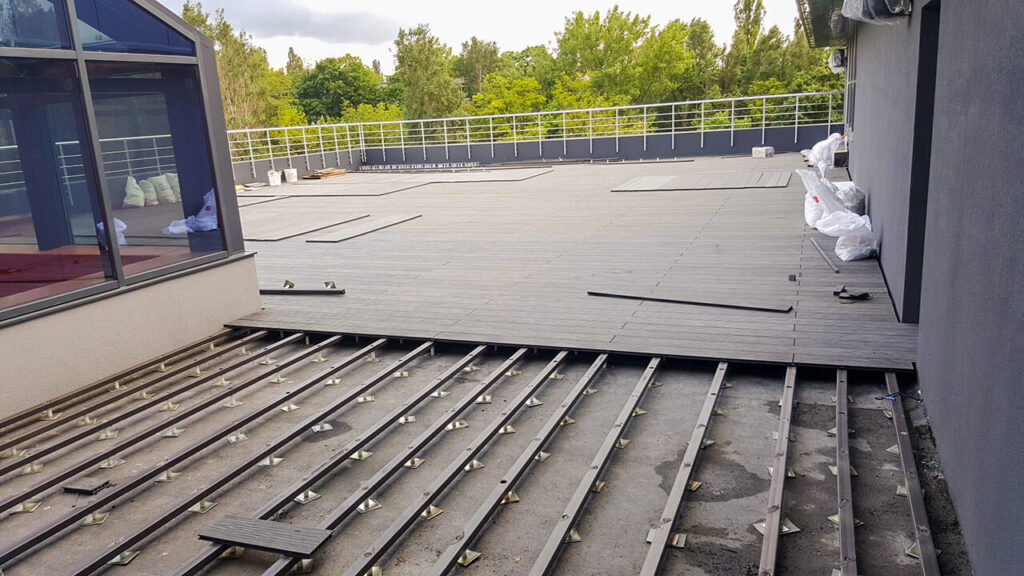
Most importantly, this is when the part you can no longer see after installation begins to do its job: the substructure.
The Most Important Part Is Hidden Beneath the Deck
Most decking problems are not caused by the composite decking boards themselves but by installation mistakes.
Once the deck surface is installed, these errors are almost invisible. Yet they can lead to deformation, sagging, water accumulation, and a significant reduction in the lifespan of the entire structure.
That is why professional installation is not just a recommendation—it is a necessity.
Four Installation Mistakes That Must Be Avoided
1. One Joist Supporting Two Board Ends
Each board end must have its own support.
If two boards are attached to the same joist, the installation does not comply with the recommended installation method. This solution does not provide sufficient structural stability and may lead to joint movement or deformation over time.
2. Incorrect Joist Spacing
Every decking manufacturer specifies the maximum allowable spacing between joists.
For example, for Bruggan Multicolor decking, the maximum joist spacing is 366 mm (14.4 inches).
This is not merely a recommendation—it is a technical requirement that ensures proper load distribution, deck rigidity, and long-term durability.
3. Inadequate Drainage and Ventilation
Composite decking is resistant to rain—that is a fact. Problems arise when water accumulates beneath the deck and cannot drain freely.
Constant moisture under the structure creates unfavorable conditions for the entire support system. Therefore, the installation must include:
- effective water drainage;
- natural ventilation beneath the deck;
- the correct slope of the structure.
4. Insufficient End Gap Between Boards
Composite decking boards expand and contract with temperature changes. For this reason, expansion gaps must always be provided during installation.
The minimum gap between board ends should be 3–4 mm (1/8–5/32 inch).
Without sufficient spacing, thermal expansion may cause boards to press against each other, negatively affecting the appearance and geometry of the deck surface.
What Should Be Checked Before Installation Is Completed?
Once the deck boards are installed, it becomes almost impossible to assess the quality of the hidden work.
For this reason, we recommend inspecting the substructure before the joists are covered by decking boards.
Pay attention to:
- proper joist spacing;
- board joints and their support points;
- adequate expansion gaps;
- ventilation beneath the deck;
- the drainage system.
A few minutes of inspection today can help avoid costly repairs in the future.
Quality Installation Is the Foundation of a True Warranty
Even the most expensive or innovative decking board cannot compensate for installation mistakes.
That is why at WoodPlast we place equal emphasis on material quality and compliance with proper installation practices. The true longevity of a deck depends not only on the characteristics of the decking boards but also on what lies beneath them.
Remember: a beautiful deck is not only what you see on the surface. It is also a professionally built structure that remains hidden yet works every day to ensure strength, stability, and long-term durability.